
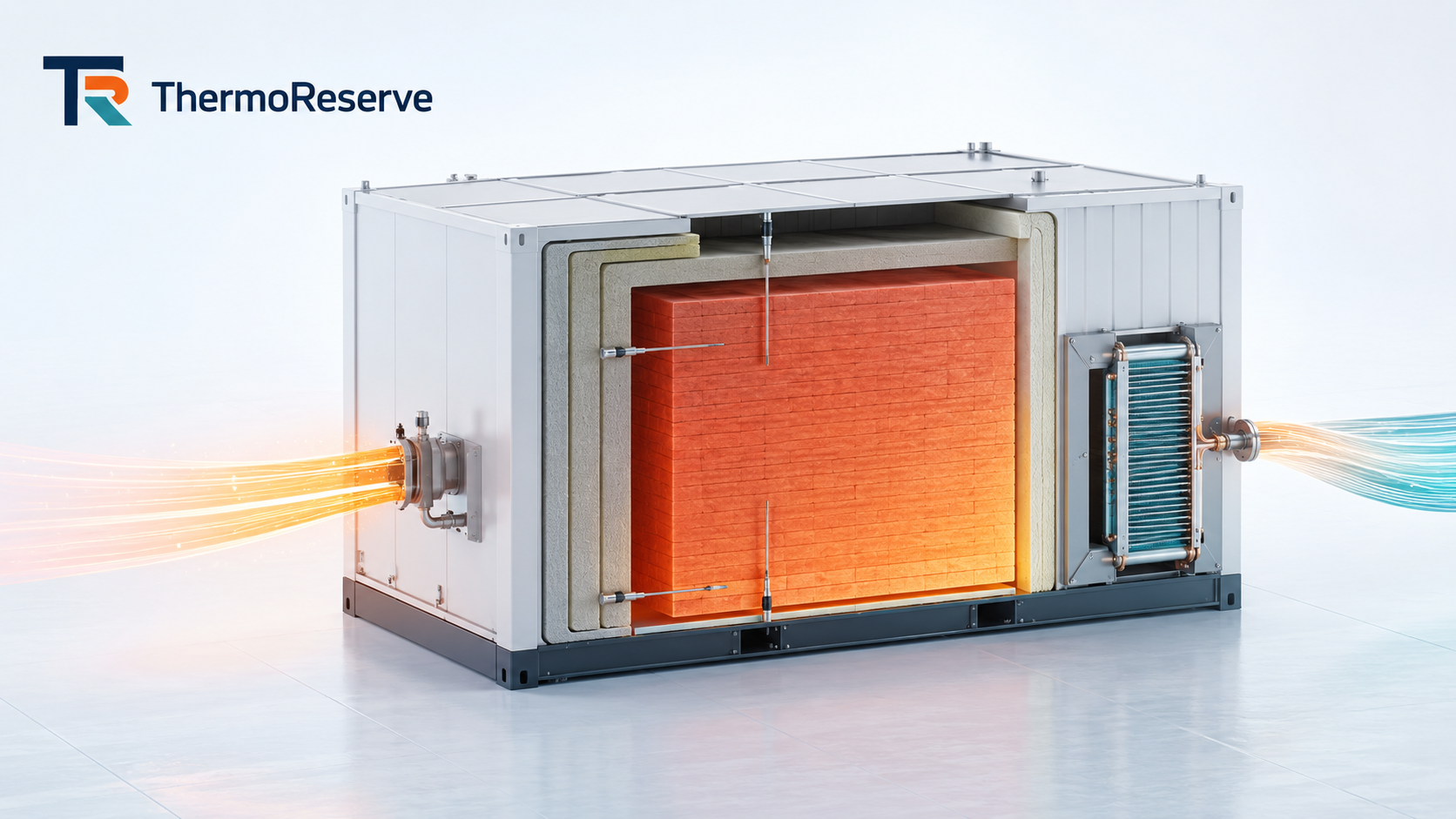
Electricity, renewable heat and recovered industrial heat are not always available at the same time that a building or process needs them. Thermal energy storage helps bridge that timing gap by storing energy as heat or cold and delivering it later as a useful thermal service.
A simple definition
Thermal energy storage, commonly shortened to TES, is the temporary storage of energy in a material or system so that it can be used later for heating, cooling or another temperature-dependent process.
The stored quantity is normally expressed as thermal energy, for example kilowatt-hours thermal (kWhth) or megawatt-hours thermal (MWhth). This distinction matters because TES is designed primarily to deliver heat or cold, rather than to return electricity to the grid.
How does thermal energy storage work?
Every TES installation has three functional stages. The equipment used in each stage depends on the storage temperature, material, charging source and customer application.
Electricity, renewable heat, recovered heat or another thermal source transfers energy into the storage system.
A storage medium retains the energy. Insulation, containment and temperature management limit losses and protect the surrounding environment.
Heat exchangers, air, water or another heat-transfer fluid deliver useful heating, cooling or process energy at the required rate and temperature.
A TES product is more than a storage material. It also requires charging, containment, insulation, heat transfer, measurement, control and safe integration.
Three main ways to store thermal energy
TES technologies are commonly grouped according to the physical mechanism used to retain energy. No single mechanism is best for every application.
Sensible heat storage
Energy is stored by raising or lowering the temperature of a material without intentionally changing its phase. Water, rocks, ceramics, concrete, oils and molten salts are examples used in different temperature ranges.
The usable capacity depends on the mass of material, its heat capacity and the permitted temperature change.
Latent heat storage
Energy is stored and released during a phase transition, often melting and solidification. These systems are commonly called phase-change-material, or PCM, storage.
They can provide relatively high storage density within a narrow temperature range, but material stability and heat transfer require careful engineering.
Thermochemical storage
Energy is stored through reversible chemical or sorption processes. The thermal energy is recovered when the reverse reaction is initiated.
Thermochemical approaches may offer high storage density and long-duration potential, although many solutions require more complex materials and process control.
TES can store heat or cold
Hot thermal storage
Hot storage retains energy above the required delivery temperature. Applications range from domestic hot water and space heating to steam, drying, industrial process heat and high-temperature operations.
Cold thermal storage
Cold storage retains cooling capacity below the temperature of the application. Chilled-water, ice and PCM systems can shift cooling production away from periods of high electricity demand.
Temperature is not merely an operating detail. It determines the quality and usefulness of the stored energy, influences material selection and insulation, and affects which charging and discharge technologies can be used. Terms such as low, medium and high temperature vary between sectors, so the required delivery temperature should always be stated explicitly.
The specifications that determine real performance
Two TES systems with the same quoted energy capacity can perform very differently. A meaningful technical comparison should include at least the following parameters.
For example, a system with 200 kWhth of usable capacity could theoretically deliver 20 kWth for about 10 hours. In practice, the available duration may differ because discharge power and temperature can change over time, and because controls maintain operating and safety limits.
Where can the charging energy come from?
Electric charging
- Grid electricity during suitable price or capacity periods
- Solar PV or other renewable electricity
- Resistance heating for direct power-to-heat conversion
- Heat pumps where the temperature range makes them suitable
Thermal charging
- Recovered heat from industrial processes
- Solar thermal energy
- Heat from boilers, combined heat and power or district systems
- Heat recovered from cooling or refrigeration equipment
The best charging method depends on the required storage temperature, available energy source, electricity and fuel prices, site constraints and operating schedule. A project should evaluate the complete energy pathway, not only the storage unit.
Where does thermal energy storage create value?
TES is most useful when there is a mismatch between when thermal energy can be produced and when it is needed. Typical value pathways include:
- Shifting heating or cooling production away from expensive periods
- Reducing electrical peak demand associated with thermal loads
- Converting more local renewable electricity into useful heat
- Capturing heat that would otherwise be rejected or wasted
- Supporting process continuity through thermal buffering
- Increasing operational flexibility during electrification
- Separating heat-generation power from peak heat demand
- Supporting buildings, industry and district energy systems
A thermal store does not automatically create all these benefits. The actual value depends on the demand profile, tariffs, charging source, temperature match, number of useful cycles and performance of the integrated system.
Is TES a replacement for battery storage?
Usually, this is the wrong comparison. Batteries store electricity and can return electricity rapidly. TES stores energy for a thermal service. If the final demand is heat or cooling, storing the energy in thermal form can be technically and economically attractive. If the site needs electricity during discharge, an electrical battery may be the more direct solution.
Some sites benefit from both. Electrical storage can manage fast power requirements, while TES manages thermal capacity and longer heat-side shifting. The correct choice depends on which service the customer actually needs.
What TES does not solve by itself
TES is not a universal answer for every energy problem. A credible assessment should also consider:
- whether there is enough recurring thermal demand to use the stored energy;
- whether the storage and customer systems have compatible temperature levels;
- whether charge and discharge power match the available time windows;
- whether space, structural loading and connection capacity are available;
- whether thermal losses are acceptable for the intended storage duration;
- whether materials, pressure, temperature and heat-transfer fluids meet safety and regulatory requirements;
- whether monitoring can verify delivered energy and customer value.
This is why a TES project should start with the thermal demand, not with a preferred storage material or a headline capacity. The customer needs useful energy at a defined temperature, power and time. The storage system must be designed around that requirement.
The ThermoReserve perspective
ThermoReserve is developing modular thermal energy storage products intended to make stored heat practical, measurable and integrable. Our initial focus is high-temperature thermal energy storage, while the wider platform can evolve toward additional temperature ranges and storage materials as applications require.
From our perspective, a useful thermal-storage product must combine the storage medium with controlled charging, effective insulation, reliable heat transfer, measurement, safety and a clear connection to the customer’s thermal demand. The objective is not simply to hold a high temperature. It is to deliver useful thermal energy at the required power and temperature, when the customer needs it.
Further reading
Could thermal storage fit your application?
A useful first assessment considers the required temperature, thermal demand profile, available charging sources, power, duration and site-integration constraints.