
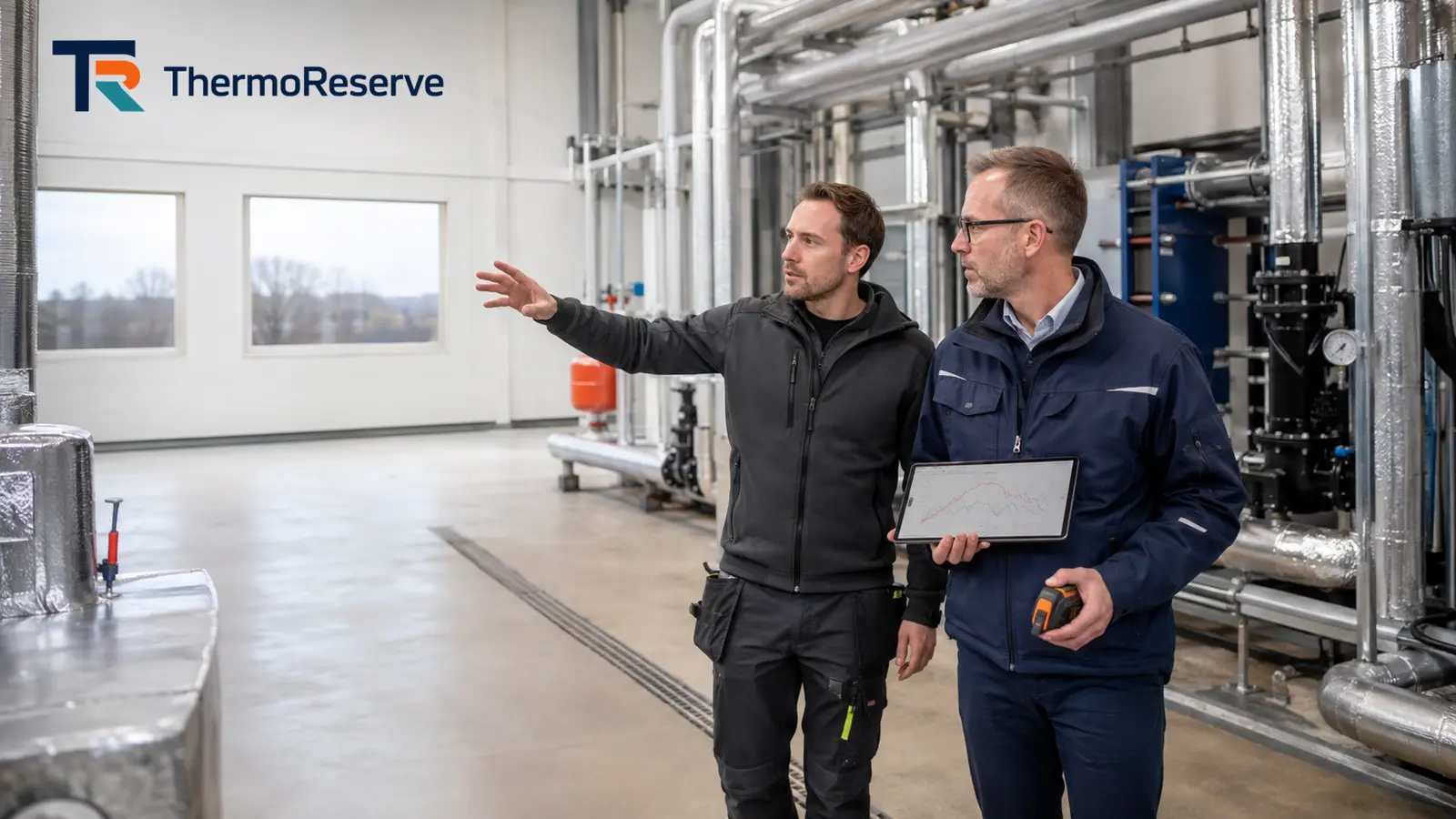
Thermal energy storage can create valuable flexibility, but it is not automatically the right solution for every factory, commercial building or heat network. A useful thermal energy storage site assessment begins by testing whether the site has a real timing problem, a compatible thermal duty, sufficient utilisation and a practical route to measurable value.
This guide helps energy managers, property owners, industrial companies and technical partners decide whether thermal energy storage deserves a structured feasibility study at a particular site. It is an early screening method, not a substitute for engineering design, safety assessment or a commercial proposal.
If you are new to the subject, begin with What Is Thermal Energy Storage? . If the opportunity already appears credible and you need to define capacity, power, temperature and duration, continue to How to Specify a Thermal Energy Storage System .
Promising early signals
- A significant, recurring heating, cooling or process-heat demand
- Energy available at a different time from thermal demand
- Defined supply and return temperatures
- Repeated operating cycles or predictable schedules
- Site data that can support a credible baseline
Reasons to pause
- No meaningful timing mismatch between supply and demand
- Very low or irregular storage utilisation
- Unknown temperature, power or operating profile
- No practical space or thermal connection
- A simpler efficiency measure solves the problem better
Start with the thermal service, not the storage technology
A thermal energy storage system is useful only when it improves the delivery of heating, cooling or process heat. The receiving load therefore defines the problem. Its required temperature, thermal power, duration, timing, acceptable interruptions and interface conditions must be understood before selecting a storage medium or module.
Energy efficiency should also be examined first. Heat recovery, insulation, process control and plant-level thermal optimisation may reduce the required storage size or remove the need for storage entirely. A credible site assessment should therefore consider storage alongside the best practical alternatives.
Six screening gates for thermal energy storage suitability
Is there a measurable thermal demand?
Identify what needs heat or cooling, when it operates, the peak and average thermal power, and how demand varies across cycles, days and seasons.
Key evidence: metered thermal data, fuel use, equipment ratings or a defensible calculated load profile.Is the required temperature compatible?
Stored energy must be delivered at a useful temperature after heat-transfer and distribution losses. Temperature quality can matter as much as total energy capacity.
Key evidence: required supply and return temperatures, process limits and allowable temperature variation.Is there a useful timing mismatch?
Storage becomes relevant when energy can be captured or generated at one time but useful thermal demand occurs later. Without this separation, direct energy use may be simpler.
Key evidence: overlapping time series for the available energy source and the receiving thermal load.Will the storage operate often enough?
A technically functional system may still have a weak business case if it cycles rarely or if only a small share of its capacity is regularly used.
Key evidence: expected cycles, usable energy per cycle, seasonal operation and annual thermal throughput.Can it be integrated safely and practically?
Review space, access, structural conditions, charging power, heat-transfer equipment, ducts or pipework, controls, maintenance access and applicable safety requirements.
Key evidence: site drawings, equipment layout, utility capacity and an initial interface description.Can the value be measured?
Define the baseline, operating strategy and performance indicators before installation. Technical, economic and environmental outcomes should be evaluated separately.
Key evidence: current energy cost, peak exposure, fuel use, operating constraints and an agreed measurement plan.Which energy sources can charge the storage?
A suitable site needs both a thermal demand and an energy source that can charge the reserve. The source may already be thermal, or electricity may be converted into heat. Each pathway creates different equipment, control and economic requirements.
Electricity-to-heat
Charging may be scheduled around electricity prices, renewable availability, contracted power, grid constraints and production priorities.
Recovered heat
Heat from an exhaust, batch process or other source may be stored when it does not coincide with a receiving load. Temperature, contamination and capture cost are critical.
Controllable heat generation
Electric boilers, heat pumps, solar thermal systems or other suitable equipment may charge storage when operating conditions are favourable.
Thermal storage can connect periods of favourable electricity availability or recoverable heat with later thermal demand. These are system-level opportunities, not guarantees for an individual site. The source, timing and customer duty still need to be evaluated together.
What data should an initial site assessment collect?
Screening quality depends on data quality. A full year of representative data is valuable where seasonal effects matter, while process-cycle data may be more important for a repeatable batch operation. Where direct thermal metering is unavailable, a first profile may be reconstructed from fuel consumption, equipment power, operating hours, temperatures and production records, with its uncertainty stated clearly.
Demand and temperature
Hourly or cycle-based demand, supply and return temperatures, peak and average power, duration and service criticality.
Energy source and timing
Electricity, renewable production or recoverable heat profiles, source temperature, available power and controllability.
Costs and constraints
Tariffs, fuel costs, peak-power exposure, operating schedules, grid limits, production constraints and maintenance requirements.
Space and interfaces
Available area, access, foundations, distance to source and load, ducts or pipework, heat exchangers and plant-room conditions.
Signals and operating logic
Existing BMS, PLC or EMS interfaces, sensor availability, permitted charging windows, process interlocks and manual overrides.
Baseline and KPIs
Useful heat delivered, thermal losses, peak reduction, energy cost, emissions methodology, availability and operational impact.
Avoid designing from electricity data alone. Electrical consumption may show when energy enters the site, but it does not by itself define the required thermal output, temperature or process conditions.
Use green, amber and red signals, not a false-precision score
Early screening rarely justifies a single numerical score. A transparent signal matrix is often more useful because it shows which assumptions are strong, which need investigation and which may stop the project.
| Screening area | Green signal | Amber signal | Red signal |
|---|---|---|---|
| Thermal demand | Recurring and measured | Estimated or variable | Small, rare or unknown |
| Temperature | Clearly defined and compatible | Variable or not fully characterised | Incompatible with safe useful delivery |
| Timing | Clear source-demand mismatch | Possible but inconsistent mismatch | Energy can already be used directly |
| Utilisation | Frequent expected cycling | Seasonal or uncertain operation | Very limited annual use |
| Integration | Space and interfaces are available | Modifications or approvals are needed | No practical or safe installation route |
| Evidence | Baseline and KPIs are available | Additional metering is required | No credible way to verify value |
An amber signal does not mean “no.” It identifies a question that should be resolved during the pre-study. A red signal in one fundamental area, such as no usable thermal demand or no feasible integration route, may be sufficient to stop or redesign the concept.
Compare storage with the credible alternatives
A good assessment does not compare the proposed TES system only with the existing system. It also examines the best practical alternative. Depending on the site, that alternative may be direct use of available heat, insulation, process optimisation, a heat exchanger, a heat pump, an electric boiler, a larger grid connection, changed operating schedules or electrical storage.
| Option | Usually worth considering when | Main question |
|---|---|---|
| Direct energy use | Energy availability already coincides with thermal demand | Does storage add value beyond avoidable complexity and losses? |
| Efficiency improvement | Demand or heat losses can be reduced economically | Can the underlying energy need be removed first? |
| Heat pump | A suitable low-temperature source can be upgraded efficiently | Does it meet the required temperature and operating conditions? |
| Electric boiler or heater | Heat is needed when electrical capacity and prices are acceptable | Is shifting the electrical input valuable enough to require storage? |
| Battery storage | The required output is primarily electricity or fast electrical response | Is the site trying to solve an electrical duty or a thermal duty? |
| Thermal energy storage | Useful heat or cooling is required after the best charging period | Can stored thermal output meet the duty with adequate utilisation? |
Three simplified application examples
Concentrated heat demand
A production step needs a repeatable period of high thermal power. Storage may charge between batches and discharge during the process, subject to temperature and integration requirements.
Source and demand do not coincide
An exhaust stream contains usable heat, but the receiving process operates later. Storage may bridge the timing gap if heat can be captured cleanly and economically.
Predictable heating demand
A commercial property has measurable heating or hot-water demand and suitable charging periods. Storage may support load shifting if space, utilisation and the building-side interface are favourable.
These examples indicate where assessment may be worthwhile. They do not establish performance, savings or suitability without site-specific data.
A practical screening process
When should a site proceed to a feasibility study?
A structured feasibility study is justified when the main screening gates are positive, the remaining uncertainties can be resolved with reasonable effort and the opportunity is material enough to investigate. The next stage should convert the site problem into engineering requirements and compare alternative concepts using consistent technical and financial assumptions.
That study should define usable storage capacity, charging and discharging power, temperature range, duration, heat-transfer interfaces, losses, control logic, safety requirements, installation constraints, measurement boundaries and the commercial baseline. These topics are explained in How to Specify a Thermal Energy Storage System .
The ThermoReserve perspective
ThermoReserve approaches site screening as a qualification step, not as a reason to force thermal storage into every application. A credible opportunity should have measurable thermal demand, a meaningful timing mismatch, compatible temperatures, practical integration and a clear method for verifying value.
Our initial product focus is high-temperature modular thermal energy storage, while the appropriate configuration should always follow the application. In commercial buildings, this may mean shifting heating demand or using locally available electricity more effectively. In industrial applications, the same principles may apply to process heat, recovered heat and electrification.
Where direct energy use, efficiency improvements or another technology provide a simpler and stronger solution, that should be identified early. The objective is not to maximise the number of storage projects. It is to identify applications where thermal storage can become a measurable and repeatable part of the energy system.
References and further reading
- International Energy Agency, Renewables for Industry , industrial heat electrification, efficiency and thermal-storage context.
- International Energy Agency, Electricity 2026: Flexibility , industrial and building demand flexibility.
- IRENA, Medium- and High-Temperature Thermal Energy Storage , power-to-heat and industrial applications.
- European Commission CORDIS, Waste Heat Valorisation , heat recovery, upgrading and storage in process industries.
- U.S. Department of Energy, Thermal Energy Storage , TES fundamentals and building applications.
Start with a structured site conversation
If your site has measurable thermal demand, a possible timing mismatch and a practical integration opportunity, ThermoReserve can help determine whether a more detailed assessment is justified.